
.png)
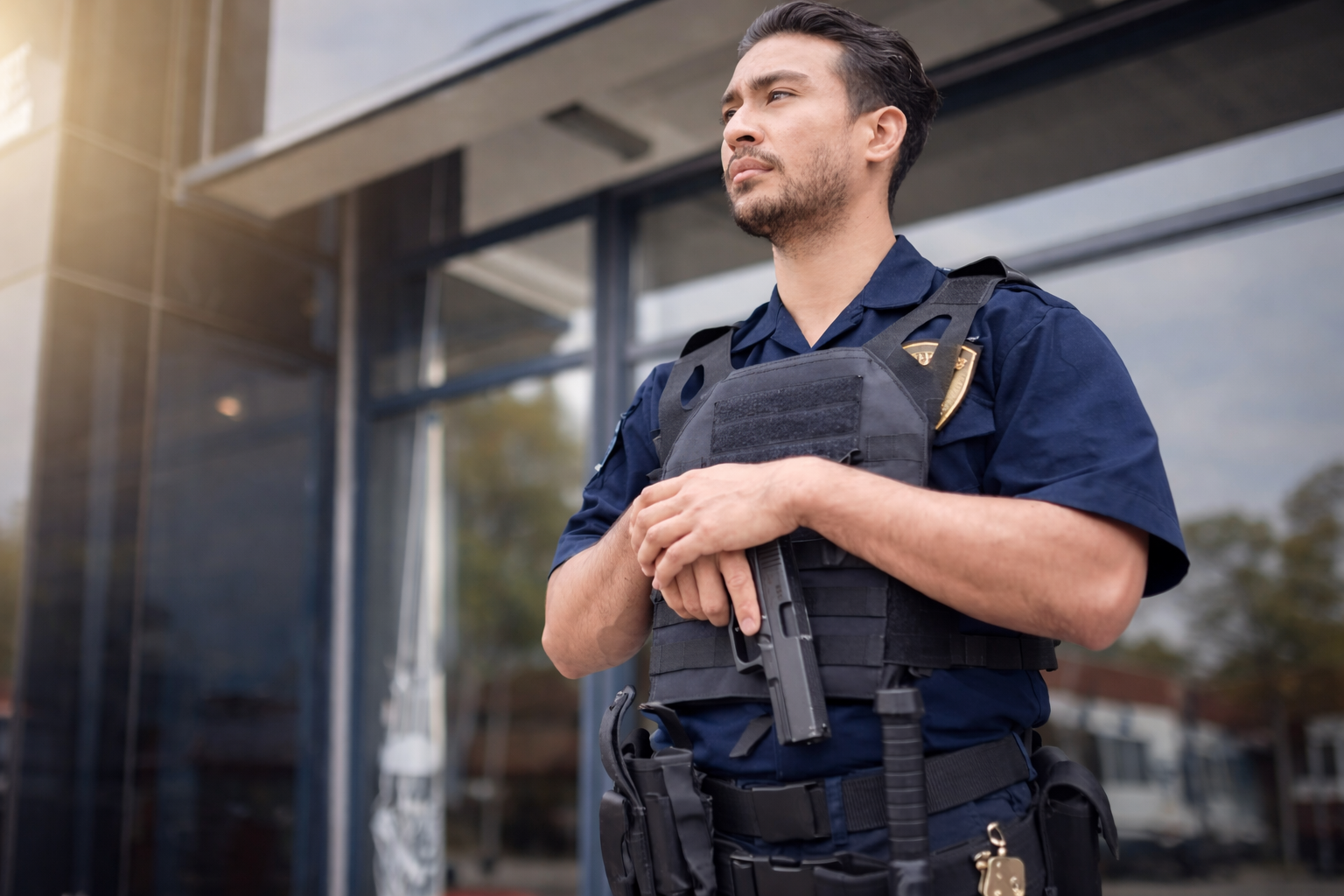
Armed security officers are used in places where security concerns are more serious and the consequences of a threat can be much higher. Their job is not only to stand watch. They are there to protect people, property, and operations in settings where a stronger security presence is necessary.
Because they carry a firearm, the role comes with more responsibility, more scrutiny, and stricter legal expectations. That is why it is important to understand what armed security officers actually do, where their authority begins, and what legal limits shape their actions on duty.
For anyone evaluating security services, that distinction matters. Armed security is not simply an upgraded version of unarmed coverage. It is a separate level of service used in different kinds of environments and governed by tighter rules.
An armed security officer is a licensed security professional who carries a firearm while performing protective duties on a property or at a specific post.
At the most basic level, the role is about protection. But in practice, that protection takes several forms. It includes watching for threats, controlling access, maintaining a visible presence, responding to incidents, and helping keep the site stable during tense situations.
In many environments, armed officers also serve as a deterrent. Their presence can reduce the likelihood of theft, violence, trespassing, and other serious disruptions. That visible deterrent is one reason armed security is often placed in locations with higher exposure to risk.
Still, the job is not only about being present. It is also about judgment. Armed officers are expected to recognize developing threats, stay calm under pressure, and act within legal and procedural boundaries.
Not every property needs armed security. In many places, unarmed coverage is enough to control access, monitor activity, and respond to routine issues.
Armed security is usually chosen when the environment presents a higher level of risk. That may involve valuable assets, sensitive operations, a history of serious incidents, or a setting where the consequences of a security failure would be severe.
This is why armed officers are often used in financial settings, certain retail environments, government related facilities, some healthcare properties, and other locations where a stronger protective presence may be justified.
The decision should not be based on appearance. It should be based on risk. A site should have the level of protection that matches its actual exposure, not simply the strongest option available.
Before an armed security officer can be effective, the officer needs to understand the site itself.
That usually starts with learning the property layout, the access points, the restricted areas, the daily flow of people, and the most likely risks connected to that location. An officer assigned to a financial institution will not work the same way as one assigned to a healthcare facility or a high value retail site.
This early understanding matters because security is not supposed to be improvised. Armed officers are expected to work from clear procedures, known priorities, and site specific instructions.
Those instructions often include where the officer should be posted, how access is handled, how patrols should be performed, how incidents must be reported, and when law enforcement should be contacted. That structure helps keep the role controlled and professional.
This is where many misunderstandings begin.
Armed security officers do have authority, but that authority is limited. Carrying a firearm does not make them police officers, and it does not give them general law enforcement power.
Their authority usually comes from a combination of state law, licensing rules, company policy, client instructions, and the rights of the property owner. In most cases, they are operating on private property and acting within the scope of the security duties assigned to them there.
That means they may be authorized to monitor entrances, enforce site rules, deny unauthorized access, respond to threats, and help protect people on site. It does not mean they can act outside legal boundaries or assume powers reserved for law enforcement.
Understanding that difference is essential. Armed security officers have an important role, but it is still a private security role.
One of the most important parts of armed security work is knowing that authority and force are not the same thing.
An armed officer may have the authority to protect a site, but that does not mean force is freely available as a response. In reality, the legal standard for using force is narrow, and the responsibility attached to it is high.
In most situations, force is only justified in limited circumstances such as self defense, defense of others, or preventing serious harm, depending on the applicable law. Even then, the response must be legally justified and consistent with training and policy.
The firearm is not a routine tool for solving problems. It is the most serious tool the officer carries, and it is meant for the most serious situations. That is why the use of a firearm is treated as a last resort, not a first response.
Even though the role involves higher risk readiness, much of an armed officer’s work still looks like structured security coverage.
On a normal shift, an armed security officer may monitor entry points, verify credentials, observe visitor behavior, patrol the property, watch for suspicious activity, and respond to emerging concerns. In some settings, the officer may also protect a specific person, secure a sensitive area, or remain posted near valuable assets.
These daily responsibilities matter because many incidents begin long before they become emergencies. A trained officer is expected to notice the early warning signs, respond appropriately, and prevent a problem from developing further.
That is one reason the role depends so heavily on awareness. Presence matters, but awareness is what makes that presence effective.
Many people assume armed officers spend most of their time dealing with major incidents. In reality, much of the job involves ordinary interaction.
They may speak with employees, visitors, contractors, vendors, or customers throughout the day. They may give directions, explain site rules, check identification, answer questions, or step in when a situation becomes tense.
This is where communication becomes critical. A professional armed security officer must be able to stay calm, speak clearly, and manage interactions without creating unnecessary tension. In many cases, a situation is resolved through presence and communication long before it becomes something more serious.
That balance matters. The officer must project authority while still acting professionally and with control.
Armed security officers are often first to respond on site, but they are not the final authority in major criminal incidents or emergencies.
When a situation goes beyond the scope of site security, law enforcement must be contacted. Once officers arrive, the armed security officer may help secure the area, share information, preserve order, and support the response within the limits of the assignment.
This handoff is an important part of the role. Good security work includes knowing when the situation is still within site control and when it must move beyond it.
A strong officer does not try to do everything alone. A strong officer understands when escalation is necessary.
Because armed security officers carry a firearm, the training requirements are usually more demanding than those for unarmed personnel.
In many jurisdictions, officers must complete additional licensing steps, pass background checks, qualify with a firearm, and complete training related to legal responsibilities, safety standards, and use of force. They may also need ongoing training to maintain their status.
That training is not only about technical handling. It also involves judgment, restraint, situational awareness, and understanding how quickly a decision can carry legal and human consequences.
This is one of the clearest differences in armed security. The role depends not only on readiness, but on disciplined readiness.
Armed security officers work under a high level of accountability because their actions can have serious consequences.
Every decision made on duty can be judged against legal standards, company policy, and site procedures. That includes incident response, physical intervention, access decisions, and any use of force.
This is why professionalism is so important in armed security. The role is not simply about being capable of responding. It is about responding in a way that is lawful, measured, and consistent with the responsibility of the post.
A well run armed security service should reflect that standard at every level.
Armed security makes sense when the risks on site justify a stronger protective presence.
That may be because of the type of assets involved, the nature of the environment, prior security concerns, or the potential harm that could result if a threat is not contained quickly. In those cases, armed officers can provide a level of deterrence and preparedness that unarmed coverage may not be designed to deliver.
At the same time, armed coverage should never be treated as automatic. The better question is not whether armed security is stronger. The better question is whether it fits the site.
That is the standard that should guide the decision.
Armed security officers play a critical role in environments where risk is higher and stronger protection is needed. Their work includes deterrence, observation, access control, incident response, and protection of people and assets under pressure.
But the role is defined just as much by its limits as by its responsibilities. Armed officers do not operate with unlimited authority, and the presence of a firearm does not remove the need for judgment, restraint, and legal compliance.
That is what makes professional armed security valuable. It combines readiness with control and authority with accountability.
When a property requires a higher level of protection, the right security partner matters. Stonewall Security provides professional security services built around site needs, operational demands, and the level of risk a property actually faces.
Reach out to Stonewall Security to discuss your environment and find the armed security solution that fits your property, your concerns, and your day to day operations.

