
.png)
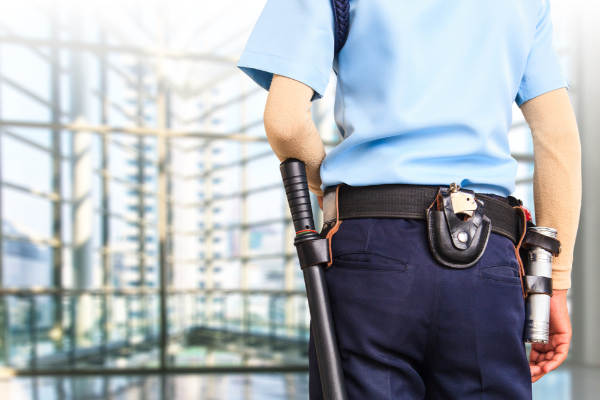
Yes, security guards can carry guns, but there are specific requirements. A guard must have the state’s armed security credential and work for a company that is licensed to provide armed security services. A standard security guard license isn’t enough.
That distinction is especially important for the person hiring the security company. If an improperly credentialed guard shows up on your property carrying a firearm, your contract may not protect you from the risks and liability that can follow.
The key is knowing what each state requires, what an armed guard is legally allowed to do, when armed security makes sense, and how to verify a provider before hiring them.
Armed security is regulated at the state level, so the answer to whether a guard can carry a gun changes depending on where the property sits. The underlying structure is fairly consistent across the country.
Nearly every state issues a baseline license or registration that permits unarmed guard work, then requires a separate armed credential layered on top of it, along with periodic firearms qualification. What varies is the name of the credential, the agency that issues it, the amount of training required, and how often an officer has to requalify.
A few examples show how different the process looks state to state.
In California, private security is regulated by the Bureau of Security and Investigative Services (BSIS), part of the Department of Consumer Affairs. Officers hold a guard registration for unarmed work, and armed work requires a separate firearms permit with ongoing requalification.
Florida uses a tiered license system administered by the Division of Licensing within the Department of Agriculture and Consumer Services (FDACS), with one license class covering unarmed work and a separate class required for armed assignments.
New York is among the more demanding states because guard registration runs through the Department of State, while the authority to carry comes from a pistol permit issued at the local level. In New York City, that means going through the NYPD License Division, which adds time and scrutiny that most states do not.
Under Washington state law, an armed private security guard can carry a gun while performing their job duties if they have met the firearm proficiency requirements set by the Washington State Department of Licensing.
Requirements change, and the current specifics on training, renewal, and firearms authorization are worth confirming directly with the Department of Licensing.
No, a standard guard license doesn’t allow a security guard to carry a firearm on duty. Armed security requires a separate firearms authorization.
A concealed pistol license (CPL) is different. It covers personal carry and does not qualify someone to work an armed security post. If a provider points to a guard’s CPL as proof they can work armed, that is not enough.
So when you ask a provider whether their guards are licensed and get a "yes," you have not yet learned what you need to know. Ask for the armed credential by name, and ask about the officers actually assigned to your site rather than the roster in general.
An armed officer remains a private employee. Security officers are not law enforcement and don’t hold police powers, and carrying a gun does not expand legal authority at all. Detention authority is the same limited private-citizen authority available to any employee, and arrests belong to responding police.
The firearm exists as a last resort in defense of life. It is not a tool for recovering property or for ending a confrontation faster. Any provider suggesting an armed officer will apprehend someone on your behalf is describing work the law doesn’t support.
Armed coverage answers a specific risk rather than serving as a general upgrade. The decision comes down to what sits on your property, what has already happened there, and who moves through the building during your most exposed hours.
Cash and easily resold high-value inventory are the clearest indicators, which is why banks, credit unions, jewelry retailers, and pharmacies commonly staff armed posts. Our armed security guards work predominantly in those environments.
Documented history is the other trigger. A prior violent incident, a weapon recovered on site, or repeat confrontations that escalated all change the calculation in a way that general unease does not. Some clients also face a requirement from an insurer or a corporate policy, in which case the decision has already been made for you.
For most commercial properties, unarmed security guards deliver the results that matter. Visible presence suppresses opportunistic activity, access control keeps the wrong people out of the building, and consistent daily reporting produces the pattern data that lets you correct a recurring problem instead of absorbing it month after month.
Adding a firearm changes how tenants, residents, and customers experience the property, which matters in retail and residential settings where the officer is part of the daily environment.
Yes, armed security typically costs more per hour than unarmed security. The higher rate reflects the additional credentials required for armed guards and the higher insurance costs associated with armed services.
Here’s how armed security and unarmed security rates compare:
That cost difference also makes it important to consider whether your site actually requires armed coverage.
Depending on the level of risk, some properties may benefit more from unarmed officers paired with commercial camera installation and monitoring, or from mobile patrol checks during hours when no officer is posted, rather than having a single armed position on site.
Licensed armed security guards can carry firearms while performing their duties, but whether your property needs armed security depends on its security requirements.
That depends on what sits on site, what has already happened there, and who moves through the building during the hours you are most exposed.
Stonewall Security is locally owned and staffs licensed, background-checked Washington officers across Seattle, Bellevue, Tacoma, Everett, Spokane, and our other service areas, with supervisor oversight and daily reporting on every assignment, armed or unarmed. If you are debating the two, request a security consultation, and we will respond quickly.

